
Late 1800s One Piece Apron Front Overalls Sewing Pattern | Past Patterns 0910
$23.00
Late 1800s One Piece Apron Front Overalls Sewing Pattern is an original Past Patterns design based on period drafting manuals and primary historical sources. Featuring true one-piece construction with an integrated apron front, this advanced pattern reflects authentic late 19th-century workwear worn by laborers, craftsmen, and tradesmen from circa 1870–1901. Sizes range from 32″–52″ waist and include extensive historical notes and illustrated instructions.
995 in stock
Get Free Shipping
On all US Orders over $50!
Late 1800s One Piece Apron Front Overalls Sewing Pattern | Past Patterns 0910
$23.00
Late 1800s One Piece Apron Front Overalls Sewing Pattern is an original Past Patterns design based on period drafting manuals and primary historical sources. Featuring true one-piece construction with an integrated apron front, this advanced pattern reflects authentic late 19th-century workwear worn by laborers, craftsmen, and tradesmen from circa 1870–1901. Sizes range from 32″–52″ waist and include extensive historical notes and illustrated instructions.
995 in stock
Get Free Shipping
On all US Orders over $50!
All of our patterns tell a story.
Why Choose This Pattern?

The Late 1800s One Piece Apron Front Overalls Sewing Pattern are an Original Past Patterns Design
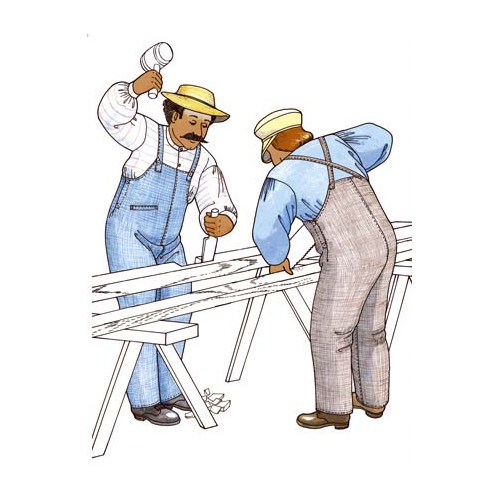
This Late 1800s One-Piece Apron Front Overalls Sewing Pattern is an original Past Patterns design, drafted from period drafting manuals and supported by extensive primary-source documentation. Pattern 0910 reproduces the distinctive one-piece construction used for men’s apron front (bib) overalls from the late 19th century, a form widely worn by laborers, craftsmen, railroad workers, engineers, and tradesmen from approximately 1870 through 1901.
About This One-Piece Apron Front Overalls Pattern
Unlike later mass-produced overalls with separate trouser and bib sections, this historical design uses a true one-piece draft, meaning the trousers and apron front are cut from a continuous piece of fabric with no side seam. This construction method is documented in period pattern drafting manuals and catalog illustrations and is visually confirmed in surviving garments, daguerreotypes, and late 19th-century trade imagery.
The Past Patterns draft for this pattern was developed from diagrams published in The Diamond Garment Cutter (1897 edition), with corroborating examples appearing in earlier and later editions spanning the 1870s through 1901. The result is a historically accurate working garment suitable for museum interpretation, living history, reenactment, theatrical costuming, and serious historical study.
Historical Research & Documentation
This pattern includes an 8-page illustrated Historical Notes section compiled by Past Patterns, tracing the evolution of apron front overalls from 1838 through 1901. The research draws upon:
- Early 19th-century paintings and illustrations
- Mid-19th-century daguerreotypes and photographs
- Original surviving apron front overalls
- Pattern drafting manuals and proportional drafts
- Mail-order and wholesale catalogs
- United States Army issue specifications and Quartermaster records
Period advertisements from Butterick, Sears, Roebuck & Co., and other manufacturers document apron front overalls offered in sizes ranging from small to very large waist measurements, confirming their widespread use by working men throughout the late 1800s :contentReference[oaicite:1]{index=1}.
Construction & Design Features
- True one-piece draft with integrated apron front
- No side seam in the trousers
- Side opening plackets for dressing ease
- Adjustable shoulder straps
- Period-correct pocket placement options
- Designed to be worn over work clothing, as documented historically
The overalls are entirely machine-sewn, with seam allowances included. Detailed fitting guidance is provided to allow adjustment over period work garments.
Fabric & Material Recommendations
Historically appropriate fabrics for late 19th-century apron front overalls include:
- Cotton twill or denim
- Cotton canvas or duck
- Cotton checks or striped workwear fabrics
- Wool jean (for colder climates or specific occupations)
Period examples were commonly produced in natural, white, blue, brown, or striped fabrics, depending on occupation and availability.
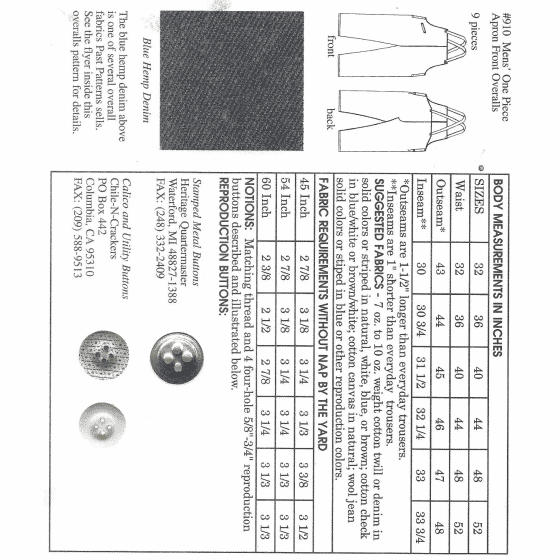
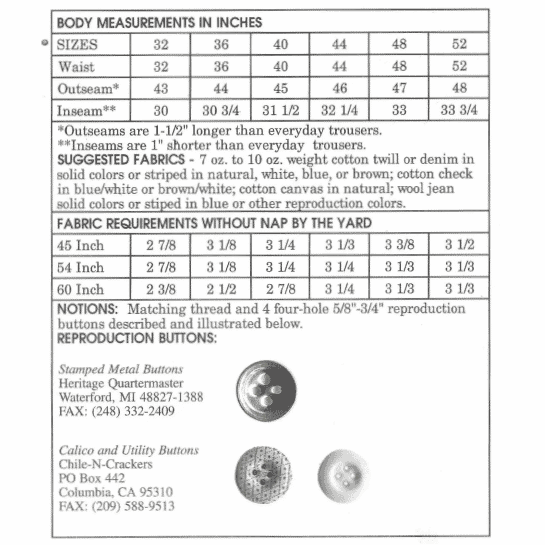
Yardage Required (45" wide fabric):
32" waist: approximately 3 1/8 yards
52" waist: approximately 3 3/4 yards
Sizes & Fit
This pattern is drafted to fit the size and proportions of a late 1800s man and includes waist sizes from:
- 32" through 52" waist
As with original period garments, experienced sewists may further customize fit based on intended layering and work use.
Skill Level
Skill Level: 4 / 5 – Advanced
This pattern is best suited to advanced sewists due to its one-piece construction, historical placket treatments, welt pocket techniques, and period-accurate finishing methods. Clear, well-illustrated instructions are provided, but prior garment construction experience is strongly recommended.
What You Receive (Printed Pattern)
- Full-size computer-drawn pattern pieces printed on durable 36" wide paper
- Extensive historical notes (8 pages)
- Detailed, illustrated sewing instructions (7 pages)
Printed patterns are produced on 20 lb. white paper and packaged for durability.
Download Version Available
A digital download version of this pattern is also available and includes multiple format options. You can view the download listing here:
Late 1800s One-Piece Apron Front Overalls Downloads
Please note: in the download version, one large pattern piece required splitting in the A0 format due to size constraints.
Copyright Past Patterns 1979–2026. All rights reserved.
Additional information
| Weight | 8 oz |
|---|---|
| Dimensions | 13 × 10 × 3 in |
Sizing Information
(Metric size sheet opens as a PDF in a new browser tab)
Preferred Vendors
Past Patterns works with vendors from all over the world to help us replicate the amazing articles of clothing. Now you can too!
Visit our preferred vendors page to order directly from some of our top recommended suppliers.
Related products
FAQ's
(Frequently asked questions)
Why are both Trowsers and Trousers listed on site?
Over the last 200 years, much like the human body, our style of language has changed. For vintage patterns, we attempt to use the language of the day where possible.
Can you grade (edit) a Vintage Revival pattern for my size?
please contact us with the specific pattern number and the specifications you require. We have staff available for this for an additional fee.
What sizes do Past Patterns patterns come in?
Our patterns, with some exceptions, are manufactured in sizes 8 through 26 for women and sizes 34 through 54 for men. Most patterns are multi-sized. For a complete listing of measurements in inches see the size chart.
Do you have vintage patterns (manufactured prior to 1950) that you want to sell?
we are always on the lookout for original, American designed, vintage patterns especially for categories outside of current items. We are interested if you have 1 pattern or 1000 patterns. Give us a call to discuss.
Why is my pattern size different from my off the rack dress size?
We use the U. S. Board of Standard Measurements to size our patterns. The ready made clothing manufacturers have their own set of sizes developed from their own statistics. For a complete listing of measurements in inches see the size chart.
How are the patterns packaged?
We package our patterns in two forms: Bond Paper and Tissue. Except for the Tissue patterns, each is slipped into a reusable plastic sleeve. Many contain documentation in the form of Historical Notes or the printer ie., Butterick. Because the patterns are printed in house to order, they can take from three to seven days. Tissue patterns, which are printed out of house, are available to ship immediately.
What does a Corset Kit contain in addition to the Corset pattern?
In addition to the pattern, the kits contain everything you need to make the corset except the thread. The kits contain, according to their type, fabric and lining, stays, clasp or busk board, back lacing, tape for finishing the edges, trim lace, ribbon, leather, tin stock, waist tape, punch and setter, eyelets, marking pencils, cording, reed and a loop turner.
Need a pattern in your language?
we can translate our instructions into just about any language
Have an old and incomplete Past Patterns item. What can I do?
The answer depends on if the pattern is still in production or not. If it is, please mail us the old pattern and we will ship you a copy of the latest pattern for a minimal fee along with normal shipping charges. If the item is no longer in production, we would need to know exactly what you have to determine the best course of action to help you.
What is the difference between a Past Patterns original pattern and a Vintage Revival pattern?
The Past Patterns originals were designed in house and based upon the research, disassembly and time of Saundra Ros Altman. These designs come from finds all over the United States reaching from San Diego, California to the Smithsonian Museum in Washington, DC. She created the initial patterns, the sizing charts and the instruction content. Many of the these patterns are multi-sized or are available in various sizes. For the most part, these designs are done taking into account the modern human body's shape, height and weight. The Vintage Revival patterns are traces or copies of an old, mass produced pattern; the first mass produced patterns came out in the 1850s. For the most part, you get exactly what came in the original package; in some cases, Saundra has appended historical notes to the instructions. The Vintage Revivals patterns, being copies of the originals, generally only come in one size and are based upon the size and shape of the human body from the era the pattern came from.
What software do you use to create patterns?
We utilize PW Studio for our designs. Isabelle Lott, a contributor over the years to Past Patterns, is the owner of the company and will be happy to answer an software related questions you have. Her software is available for licensing.
What measurements do I need to know to order a Corset Kit?
The bust and back length. The back length is measured from the prominent bone at the base of the neck to the natural waistline.
Where can I see the appropriate clothing fabrics for the 18th and 19th centuries?
You can see 1740 through 1940 fabrics in a book titled "Textile Designs" by Susan Meller and Joost Elffers. The subtitle states, "Two Hundred Years of European and American Patterns for Printed Fabric by Motif, Style, Color, Layout and Period and 1,823 Illustration in Color." What they don't say is that 90% of the swatches pictured are life size. The ISBN is 0-8109-3853-7. A second book is Wearable Prints, 1740-1860, History, Materials, and Mechanics by Susan W. Greene. The ISBN is 978-1-60635-124-6. Great books! Order it from your local library that has interlibrary loan capability if you cannot afford the price. There are now many sources for appropriate fabric through the Internet.
Where can I find antique patterns to purchase?
On the Internet try: "Patterns from the Past."
Need a pattern tomorrow?
we do offer expedited domestic shipping for extra fees. We can also expeditie international shipments but delivery dates overseas cannot be promised.
Becoming a Wholesalers of our patterns
We offer Wholesalers significant discounts that will allow both your and our businesses to flourish.
Why don't we sell PDFs of our patterns - First due to piracy. We have spent over 40 years creating and tracing these patterns along with researching them. We print and ship all of our patterns ourselves. If we started sending out PDFs, in no time, copies of our Intellectual Property would be all over the internet and we would be out of business. Second, some of our patterns are constantly being updated. We want our clients to get the BEST POSSIBLE version of our products.